
Embroidery Designs for Shirts: Stabilizer, Placement, and Hooping
How to machine-embroider a T-shirt, sweatshirt, or denim shirt: which cut-away to use, how to hoop a knit, and where a left-chest or center design goes.
Published · Updated
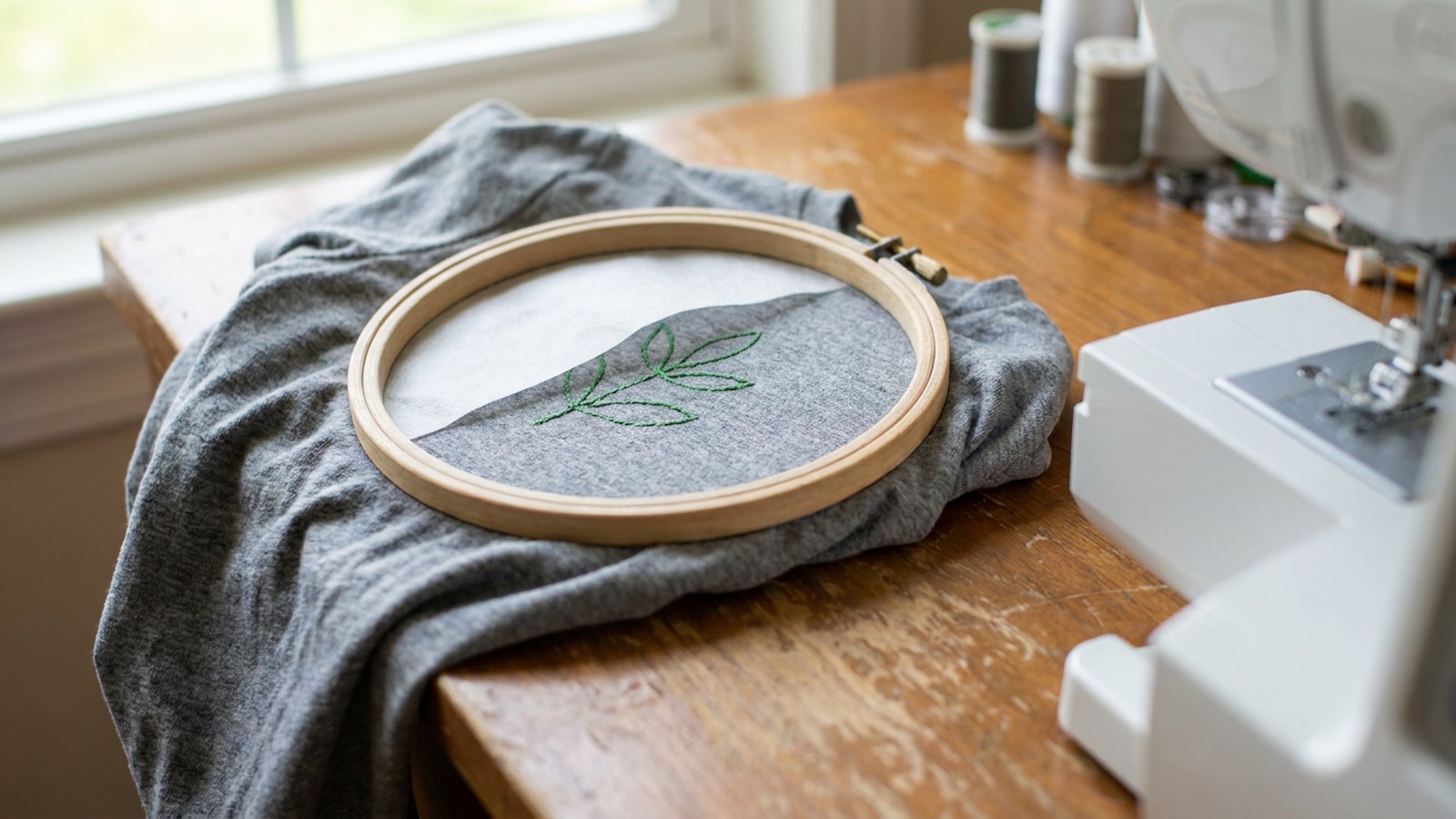
You can put a machine embroidery design on a T-shirt or sweatshirt at home. Stabilize the knit, hoop it flat, and mark where the design sits before you stitch.
On a T-shirt, Brother's fabric chart calls for one lightweight cut-away or an adhesive tear-away, and it says to avoid stitch-heavy patterns. On a sweatshirt, the same chart calls for one cut-away or an adhesive tear-away, and it says highly detailed patterns may require two layers of lightweight cut-away. For a left-chest design on a pocketless T-shirt, Embroidery Library's placement guide puts the design 7 to 9 inches down from the left shoulder seam, or 4 to 6 inches to the right of center. For a design centered on the shirt front, that guide says the top of the design is generally 3 1/2 to 4 1/2 inches from the neck, centered between the side seams.
Stabilizer for knits, hoodies, and denim
Cut-away is the backing these makers name for a knit that will be washed and worn. OESD says cut-away must be used on knits or stretchy fabrics, and it lists jersey, T-shirts, sweatshirts, and denim or other twill weaves among those fabrics. BERNINA's answer for jersey is a cut-away stabilizer, and the same article lists jersey, sweat, knit, and stretch fleece as cut-away fabrics. BERNINA says the more elastic the fabric, the sturdier the stabilizer must be.
Weight follows the shirt and the design, not a single blank. Asked which shirt quality to buy, the sources name no winner: match stabilizer weight to the fabric you have. Sulky says light-weight cotton jersey knits are tough to stabilize, because the knit stretches and can pucker. A heavier, less stretchy knit holds a denser design more readily than that thin jersey. Sulky's cut-away guide says most T-shirts use a light cut-away such as Soft 'n Sheer, while Cut-Away Plus is what you see on the back of most sweatshirts and golf shirts. Brother's US backing note says cut-away is a strong choice for medium- to heavyweight knits, and that you should consider design size, stitch count, and stitch type when you pick the backing. That note also says to keep the stabilizer from being stretched, and that a backing which stretches on the diagonal is the wrong choice.
Stitch count changes the layer. Floriani says a design about 4 by 4 inches or smaller, generally around 8,000 stitches, can sit on one piece of no-show nylon mesh, a light cut-away that is less bulky than a traditional cut-away and shows less through a thin, light-colored shirt. The same Floriani note says a medium to high stitch count, 8,000 to 12,000 stitches, calls for medium 2 oz cut-away, including satin lettering on a lightweight knit, because that backing gives the fabric body and keeps the letters from pulling the knit. Embroidery Library's T-shirt fabric note names a medium-weight 2.5 ounce cut-away and says to avoid tear-away on T-shirts, because tear-away can lead to shifting, gapping, and misalignment.
Denim is not one rule. Brother's fabric chart lists denim with one tear-away, and it says to reduce speed if the needle heats and the thread breaks. Brother's US note also names tear-away for sturdy wovens such as canvas, poplin, and denim. BERNINA names tear-away for non-stretch jeans, and cut-away when the fabric stretches. Sulky's denim note says some denim has stretch, so a light cut-away can be the backing for that fabric, and the sample in that note uses a topstitch 100/16 needle. OESD still lists denim among cut-away fabrics, and it names an adhesive cut-away, StabilStick, for hard-to-hoop jeans as well as hard-to-hoop T-shirts. Sew a test on a scrap of the same denim before the jacket or shirt you want to keep. Brother says the fabric chart is a guideline only, and to sew a test sample before the finished garment.
Hoop the shirt flat
Sulky's knit tutorial says knits should not be hooped directly in the frame, because stretching will occur. Hoop a sticky tear-away, paper side up, in a hoop a little larger than the design, then press the shirt to the adhesive along the center marks. Floriani says to fuse the mesh first if hooping tends to stretch the garment, using a piece larger than the frame.
Brother's hooping instructions limit fabric thickness to less than 2 mm (1/16 inch), because thicker fabric may cause the needle to break. Those instructions also say to always use a stabilizer on stretch fabric, lightweight fabric, a coarse weave, or fabric that shrinks the pattern, because otherwise the needle may break and cause injury. Brother also says to pull the fabric gently taut and to keep the hooped fabric from being distorted.
Needle choice matters on a knit. Sulky names a ballpoint embroidery needle in a gauge for the fabric weight: 65/9, 75/11, or 80/12. Sulky says a sharp point can cut a knit link, while a ballpoint slides between the links and keeps the stitches more even. Embroidery Library names a 75/11 embroidery needle for a T-shirt in the same range.
A hoodie or sweatshirt has a second layer behind the design. OESD's T-shirt method pulls the back of the shirt to the top of the hoop and tapes it out of the needle path so the machine stitches only the front. Use that same step on a sweatshirt or hoodie. That method also cuts two pieces of fusible polymesh cut-away, about 2 inches larger than the hoop, fuses both to the inside, and covers the design area with a water-soluble topping so satin stitches sit on the knit instead of sinking in. Brother's chart says to use a topping on extra-thick sweatshirt fabric or on fine-detail patterns. Pile and texture are a related job, covered in how to embroider on towels.
Where to mark the design
Mark the shirt before you hoop. OESD prewashes and dries the shirt, presses it inside out so the fabric is not stretched, folds it lengthwise on the shoulder and side seams, and finger-presses a center crease. For a small design high on the chest, that tutorial places the top of the design about 1 inch from the bottom of the collar, on that crease. That is a different job from the center-front mark above, which sits lower for a larger design. Use the mark that matches the design size.
Left-chest logos use the shoulder seam, not the collar. The 7 to 9 inch drop, or the 4 to 6 inch offset from center, is Embroidery Library's mark for a pocketless T-shirt. If the shirt has a pocket, that guide centers the design above or on the pocket. A hoodie chest logo can use the same shoulder-seam method when the chest is a similar size.
After stitching, trim the cut-away close to the design and leave a margin. Embroidery Library says to leave about 1/2 inch around the design. If the back of the stitches will rub skin, Sulky fuses a soft backing over the wrong side, such as Tender Touch, after the excess stabilizer is removed.
Choose a design the shirt can hold
Open designs drape. Heavy fills drape poorly on a knit. Asked which stitch to use on stretch fabric, these pages name no single stitch. They warn against stitch-heavy fills on a light knit. Embroidery Library says to choose designs that are light with open areas, and to avoid heavy or blocky fills, because heavy fills drape poorly and may pucker the shirt. That matches Brother's warning to avoid stitch-heavy patterns on a T-shirt. A name in satin lettering is a different density problem: it needs the extra body Floriani describes for medium cut-away on a light knit.
A block alphabet is one option for a name on the chest.
The block name font is coming soon at $6.00.
Loading a lettering file into software is a separate step, covered in how to add fonts to Embrilliance. Name files as a group are covered in embroidery design fonts. A three-letter monogram on a cuff is a different placement from a chest design. Lettering for that job is in monogram fonts.
To draw your own motif and turn it into a stitch file, start with how to make embroidery designs. For a lighter stitch load than a solid fill, BERNINA points to applique work with fewer stitches, and simple applique designs are that kind of motif. A winter design on a sweatshirt uses the same stabilizer and hoop. Seasonal motifs are in Christmas machine embroidery ideas. Once the file is ready, loading it on a Brother machine is covered in Brother embroidery designs.
Order of work for a first shirt
- Prewash and dry the shirt so it shrinks before the stitches do, as OESD does.
- Pick an open design, or a lettering design you have matched to a heavier cut-away.
- Fuse or stick cut-away to the inside. On a T-shirt that is one light layer for a small open design, and a heavier layer when the stitch count climbs.
- Mark left chest or center front, then hoop the stabilizer and the shirt flat.
- Tape the back layer up. Use a ballpoint needle. Add topping if the design is fine or the fabric is thick.
- Stitch a scrap of the same fabric first. Then stitch the shirt, trim the cut-away, and add a soft backing if the stitches will touch skin.
That order is the machine route for embroidery designs on shirts: cut-away, a flat hoop, and a placement mark.
Questions
How can I embroider a T-shirt at home?
Prewash the shirt, put cut-away on the inside, mark the center, hoop the knit flat, and stitch an open design with a ballpoint needle.
Can you embroider on a T-shirt?
Yes. Use cut-away under the knit, hoop the shirt flat, and keep the design from being stitch-heavy.
Can I embroider on a T-shirt?
Yes. A home machine can stitch a T-shirt when the knit is stabilized and hooped flat.
Is it hard to embroider on a shirt?
A light jersey is a challenging hoop because it stretches. Cut-away, a ballpoint needle, and an open design are what make a first shirt project workable.
What stabilizer to use for T-shirt embroidery?
Cut-away. Brother's T-shirt line is one lightweight cut-away or an adhesive tear-away, and a heavier cut-away comes in when the stitch count rises.
How do you embroider on a hoodie?
Use cut-away, often heavier than on a thin T-shirt, hoop the front flat, and tape the back layer up so the needle stitches only the front.
Can I embroider stretchy fabric?
Yes, if cut-away stays in the hoop and the fabric is not stretched while you hoop it.
How can I design my own embroidered T-shirt?
Pick an open motif or a name in satin lettering, get a stitch file, then stabilize and place it as this guide describes.
How do I embroider my own sweatshirt?
Follow the T-shirt order, with cut-away sized for a heavier knit and a topping if the fleece is thick or the design has fine detail.
Can I embroider directly onto clothes?
Yes. The needle sews the garment itself, with stabilizer in the hoop under the fabric. A patch sewn on later is a different method.
How to embroider on clothes for beginners?
Start with a prewashed shirt, cut-away, a ballpoint needle, an open design, and a test on a scrap of the same fabric.
Can you embroider on denim?
Yes. Stable denim is often stitched with tear-away. Stretch denim, and some wearable rules, call for cut-away. Test the pair you have.
Related
- FontPlaceholder
Block Name Font
A filled block alphabet for a short name that has to stay readable small, on a shirt or a label.
Sources
- Brother Industries: Fabric/stabilizer compatibility chart (2015)
- Brother Industries: Backing and topping for embroidery (2016)
- Brother Industries: How do I hoop the fabric in the embroidery frame? (2023)
- Sulky of America: The Stabilizer Basics – Cut Away and Tear Away Stabilizers (2015)
- Sulky of America: Machine Embroidered T-shirt + Tips for Stabilizing Knits (2016)
- Sulky of America: Machine Embroidery Series – Denim (2016)
- OESD, LLC: Machine Embroidery Stabilizer Basics (2024)
- OESD, LLC: How to Embroider A T-Shirt (2024)
- RNK Floriani: Stabilizing Solutions: T-Shirts, Golf, Polo Knit Shirts and Sweatshirts (2023)
- BERNINA International AG: Which stabilizer for which material? (2023)
- Embroidery Library: Embroidery Placement Guide (2026)
- Embroidery Library: Fabrics 101: Embroidering on T-Shirts (2026)