
Simple applique designs, step by step
A simple machine applique runs placement, fabric, tackdown, trim, then a satin cover stitch. Quilt cotton pairs with tearaway; a knit shirt needs cutaway.
Published · Updated
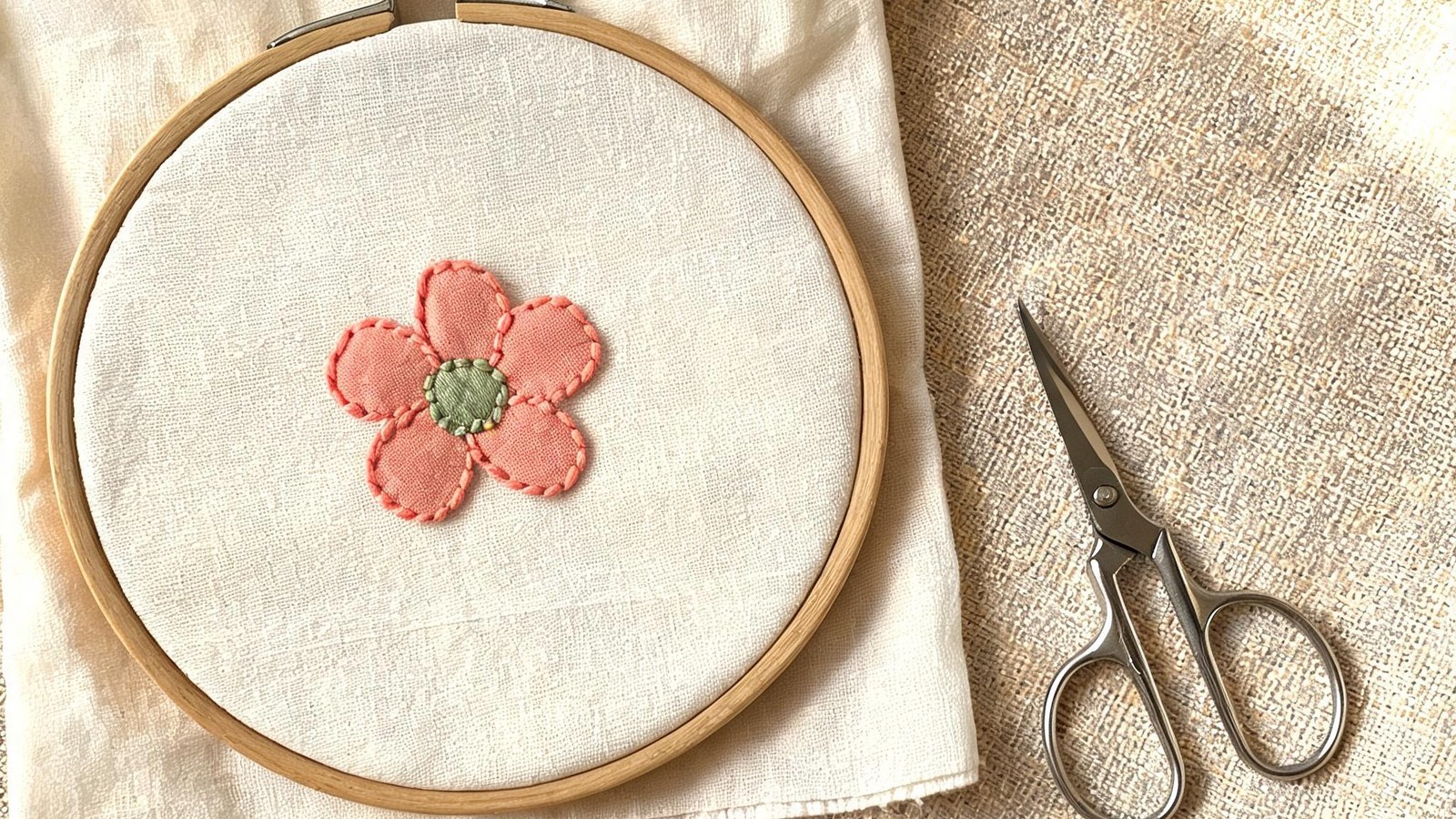
A simple applique on an embroidery machine follows the color stops in OESD's trim-in-place tutorial: a placement line, fabric over that line, a tackdown, a trim, then a cover stitch, when the design has a placement stitch, a cut line and tackdown, and a cover stitch. Baby Lock stitches each leaf as a placement line, a stitch down line, and a satin stitch line.
What applique is
Applique is fabric cut into a shape and sewn onto another fabric, which is how La Creative Mama defines it, and she uses it on quilts, clothing, and home items.
On an embroidery machine the file stops so you can add fabric, which is the trim-in-place method OESD describes: fabric goes over the placement stitch, the next color is a cut line and tackdown, and you trim while the project stays in the hoop. Pre-cut is the other method on OESD's pre-cut tutorial: the shape is cut first, the paper backing comes off, and the piece goes over the placement stitch. OESD's pre-cut tutorial calls the last color the cover stitch, and that stitch covers the raw edges.
Hand, fusible, and sewing-machine applique are the other methods La Creative Mama names, and they are lower on this page.
The machine sequence
Press the fabrics so the cloth is smooth, then hoop the background with stabilizer, which is how OESD starts: the background fabric goes in the hoop with two layers of tearaway before the hoop goes on the machine.
- Stitch the placement line. OESD calls the first color a placement stitch. Baby Lock calls the same first color a placement line.
- Lay the applique fabric right side up so it covers that line, which is what OESD says: cover the placement stitch. On a pre-cut piece, OESD peels the paper backing and places the shape evenly over the placement stitch.
- Stitch the tackdown. OESD calls the next color a cut line and tackdown, which stitches the fabric and holds it. Baby Lock calls that color a stitch down line.
- Take the hoop off the machine and leave the project in the hoop, which is what OESD and Baby Lock both do while you trim. OESD says to trim as close to the cutline as possible, and notes that a cut through the outer stitches still leaves the inner tackdown holding the fabric. Baby Lock says to clip around the outside of the stitches and to keep the scissors off those stitches.
- Put the hoop back and stitch the cover stitch, which OESD calls the last color, and that stitch covers the raw edges. Baby Lock calls the third color a satin stitch line.
Repeat placement, fabric, tackdown, and trim for each piece, then stitch the cover stitch last, which is the cycle OESD continues until every applique fabric is in place.
The floral applique is coming soon at $3.99.
Fabric and stabilizer
Quilt cotton is one of the wovens OESD lists for tearaway, along with chambray, poplin, linen, and most satins. OESD calls tearaway a common choice for applique designs, because the applique fabric itself adds some stability, so a lighter stabilizer can often be used.
JuJu names quilting cotton, knits, and other lightweight fabrics when fusing optional interfacing such as Pellon SF101. JuJu uses it on the background to add body, and on the applique pieces to make trimming easier and to reduce rippling under the satin stitch. JuJu says every project still needs a hoop stabilizer even when SF101 is already fused.
On a fabric that frays, JuJu uses a fusible web such as Heat-n-Bond Lite on the back of the applique fabric so the edges stay sealed. For pre-cut pieces, OESD uses Applique Fuse and Fix on the wrong side: fusible on one side, paper-lined on the other, peeled just before the piece goes over the placement stitch.
La Creative Mama works in cotton, muslin, linen, silk, and wool for hand and fusible applique. That list is for scrap sewing. On an embroidery machine, match the stabilizer to the cloth as OESD describes for tearaway and cutaway.
On a t-shirt
A t-shirt is a knit, so the stabilizer changes: OESD says cutaway must be used on knits or stretchy fabrics, and names t-shirts among the garments that take cutaway. OESD's knit tutorial uses Polymesh cutaway, and says the same method works for t-shirts and other lightweight knit garments.
Wash and press the shirt first. OESD lets the knit lie as it will be worn. Pulling the knit in the hoop can leave puckering once the hoop comes off, which is the result OESD describes. When the shirt is hard to hoop, OESD hoops the cutaway alone, sprays temporary adhesive, and floats the shirt on top.
OESD looks for an open, light design on knit, because a dense design can feel heavy and can leave wrinkles. An applique on a shirt still uses the placement, tackdown, trim, and cover sequence above, with cutaway under the knit, which is the knit stabilizer OESD names for t-shirts. Shirt placement and other shirt projects are in embroidery designs for shirts.
Mistakes that show up often
Puckering. JuJu traces it to fabric or stitches that need more support, and splits the fix into two jobs: fuse interfacing before hooping if the cloth needs body, and hoop a stabilizer under the stitches.
Frayed edges. JuJu says edges that peek out from under the satin stitch, or fray after washing, often mean the fabric was trimmed too far from the tack-down stitch. Trim close, just outside the tack-down line, and keep the scissors off that line, so the cover stitch can cover the raw edge, which is the trim JuJu describes. JuJu pauses when the cover stitch starts, usually as a wide zigzag, and checks that the raw edge is caught before the satin part of the cover stitch.
Placement that sits short of the line. JuJu traces a piece that fails to cover the placement lines to rushing that step. Press the fabric, smooth it so it fully covers the lines, and a temporary spray adhesive can hold it while the tackdown runs, which is the placement habit JuJu names. JuJu also slows the machine during the tackdown for cleaner corners and curves.
Thread breaks. JuJu points to the wrong needle, tension, low-quality thread, or a dusty machine. JuJu names a 75/11 embroidery needle as a starting size, and says to use an embroidery needle rather than a sewing needle.
Leave the fabric in the hoop for the trim, which is what OESD and Baby Lock both do: the hoop comes off the machine, and the project stays hooped while the extra fabric comes off.
Hand and fusible applique
A reader with a needle or a regular sewing machine can still applique. La Creative Mama names three ways: hand applique, fusible applique, and machine applique.
For hand work, La Creative Mama lays the shape on the marked spot and sews it down. Raw-edge leaves the cut edge showing, and that edge will fray, which is the raw-edge result La Creative Mama describes. She also uses felt for flower shapes, which La Creative Mama names as a hand method.
For fusible work, La Creative Mama irons the shape on with fusible web, then sews along the edge. She uses Heat and Bond in the lite strength, which is the fusible web La Creative Mama names. On a sewing machine, WeAllSew covers blanket stitch, satin stitch, and corded applique, each with fusible web under the shape. La Creative Mama sews a zigzag around an iron-on shape, and says an embroidery machine can stitch around an iron-on applique with a regular stitch or an embroidery stitch. That guided edge is a different job from the file sequence OESD uses, which stops for a placement stitch, a cut line and tackdown, and a cover stitch.
For a towel, the hoop and topping choices are in how to embroider on towels. To draw the shape yourself, start with how to make embroidery designs. For loading the applique file onto a Brother machine, see Brother embroidery designs. Winter motif ideas are in Christmas machine embroidery ideas.
OESD uses tearaway on woven applique and cutaway on knits, so the stabilizer depends on the cloth. JuJu adds optional fusible interfacing. Stitch a scrap in the same fabric before you commit a shirt or a gift.
Questions
What are common appliqué mistakes to avoid?
How do you appliqué for beginners?
What stitch is used for appliqué?
What is applique in embroidery?
A fabric shape sewn onto another fabric, which is how La Creative Mama defines it. On an embroidery machine the file stitches a placement line, a tackdown, and a cover stitch, which is the trim-in-place order OESD describes.
What is appliqué work?
Cutting fabric into shapes and sewing those shapes onto a base cloth is how La Creative Mama defines applique work, and she uses it for quilts, clothing, and home items.
How do you do appliqué embroidery?
Follow the design's color stops: placement, fabric, tackdown, trim, then the cover stitch, which is the cycle OESD repeats for each piece before the cover stitch.
Can you do appliqué on an embroidery machine?
Yes, when the design has a placement stitch, a tackdown, and a cover stitch, which is trim in place on OESD, and pre-cut on OESD's pre-cut tutorial.
What stitch covers a machine appliqué?
What fabric works for embroidery appliqué?
What are the different types of applique embroidery?
Hand, fusible, and sewing-machine applique are the three ways La Creative Mama names. Embroidery-machine work splits into trim in place on OESD and pre-cut on OESD's pre-cut tutorial. Sewing-machine work can be a blanket stitch, a satin stitch, or a corded edge, which is what WeAllSew covers.
How do you apply appliques to fabric?
On an embroidery machine, the tackdown holds the piece and the cover stitch finishes the edge, which is the order OESD uses. With fusible web, La Creative Mama irons the shape on, then sews the edge.
How to do an embroidery appliqué?
Use the same order as a first project: placement line, fabric over that line, tackdown, trim, cover stitch, which Baby Lock names a placement line, a stitch down line, and a satin stitch line.
How to make applique with an embroidery machine?
Use a design that stops for fabric, which is how OESD stitches it: placement line, fabric over that line, tackdown, trim, then the cover stitch.
How do I applique on a t-shirt?
Wash and press the shirt, put cutaway under it, and keep the knit from stretching in the hoop, which is the knit method OESD describes, then run the placement, tackdown, trim, and cover stitch from OESD's trim-in-place tutorial.
Related
- AppliquePlaceholder
Floral Applique
The same flower as an applique: a fabric flower beside a name on a shirt or towel.
Sources
- OESD: Trim in Place Applique Tutorial (2024)
- OESD: Pre-Cut Applique Tutorial (2024)
- Baby Lock: Autumn Placemats (2025)
- OESD: Machine Embroidery Stabilizer Basics (2024)
- JuJu: Applique Made Easy: Troubleshooting Applique Embroidery (2025)
- WeAllSew: Machine Appliqué Three Ways (2022)
- OESD: Machine Embroidery on Knit Garments (2024)
- La Creative Mama: How to Applique for Beginners: Hand, Machine and Fusible (2021)