
How to embroider on towels
Stitches sink into towel loops unless a water-soluble topping holds the pile down. Add a backing, place a template, then hoop the stack or float a thick towel.
Published · Updated
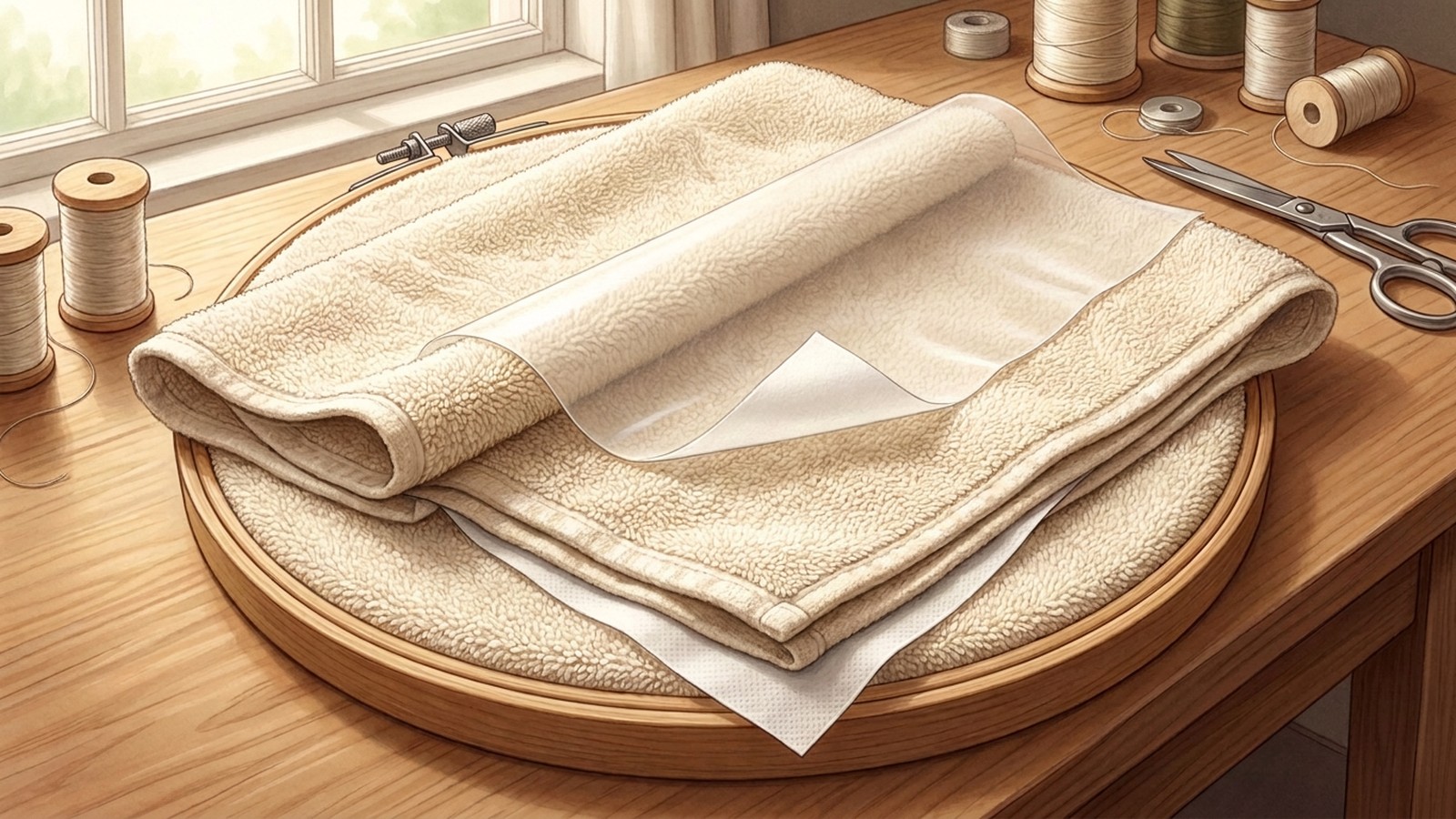
To machine embroider a name or a design on a towel so the stitches stay on the loops, lay a water-soluble topping on the pile, put a backing under the towel, then hoop the stack or float the towel if it is too thick. WeAllSew names the usual miss: stitches fall between the loops and disappear, or the design crumples when the towel is laundered. Sulky uses the two lighter films, Solvy and Super Solvy, as a topper on napped fabrics such as towels so the loops stay under the stitching and fine lettering stays readable.
Order of work
- Wash and dry a terrycloth towel before you stitch. Embroidery Library says terrycloth is cotton and will shrink.
- Match the design to the pile: open stitching on a thin towel, solid fills on terry or waffle.
- Add a water-soluble topping on high pile, and a tear-away or cutaway backing under the towel.
- Print a template, set it on the towel, and mark the center.
- Hoop the towel with the stabilizer, or float the towel if it is too thick for the hoop.
- Stitch, pull the topping off, and trim the backing.
That order is the whole job. The sections below are the choices inside each step.
Pick the towel and the design
Thin towels and plush towels are different jobs. Urban Threads uses flour sack and tea towels for light, open designs, with a layer of tear-away on the back. Urban Threads says medium-weight cutaway can show through those thinner fabrics, so tear-away is the backing they describe there, and that tear-away gives less support than cutaway, which they treat as acceptable on light, open stitching.
Terrycloth and waffle cloth are high pile. Urban Threads says embroidery on that surface tends to sink into the fabric, and recommends painterly designs or solid fills. Urban Threads says a running stitch can disappear into the texture. Embroidery Library makes the same point for terrycloth: choose solid fills, and leave light or delicate stitches for smoother cloth.
For a kitchen towel, that split is the material choice. A flour-sack or tea towel is the thin cloth Urban Threads uses for open designs. A waffle or terry kitchen towel is the high-pile cloth on that page, and it needs the topping and a denser design. Sulky answers a bath-towel question with tear-away under the towel and Solvy on top, the same stack for a plush hand towel or a plush kitchen towel.
Topping and backing
The topping is the piece that keeps stitches sitting on the pile. Janome Life uses a flimsy, film-type water-soluble stabilizer as a topping on towels, fleece, velvet, and other pile fabrics, because stitches can get lost in the pile and look patchy. Janome Life says the needle perforates that film, so it tears away after stitching, and a gift towel can go out once the scraps are gone, with a wash left optional.
Sulky uses 1 to 2 layers of Tear-Easy under a bath towel, depending on thickness, and uses Solvy as a topper. An alternate topper Sulky names is Heat-Away, pulled away after stitching so a bit remains under the stitches after washing. Sulky reserves that Heat-Away topper for a design that covers the film.
Sulky's Stabilizing at a Glance chart lists terry cloth with a 12/80 or 14/90 needle marked (U/B), 2 layers of Tear-Easy marked with an asterisk, and a topping marked (S), 1 layer, also with an asterisk. On that chart, (U) is universal, (B) is ballpoint, the topping key marks (S) as Super Solvy, and an asterisk means in the hoop. Embroidery Library uses a different stack on terrycloth: medium-weight (2.5 ounce) cutaway under the towel, water-soluble stabilizer on top, and a size 11 or 75/11 sharp sewing needle or an embroidery needle.
Those pages agree on a topping for pile and name more than one backing and needle. Tear-away is Sulky's bath-towel backing and the backing Urban Threads describes for thin, open designs. Cutaway is what Embroidery Library and Urban Threads use under terrycloth and waffle when the design is filled. Sulky's chart says to always do a test before you commit a towel you care about.
Where to place the design
Print the design at the size you will stitch and use that paper as a template. Embroidery Library marks the center point and the axis lines on the towel. In that terrycloth example, the bottom of the design is four inches above the hem, centered between the sides.
One kitchen-towel tutorial, Kreative Kiwi, sets the bottom of the design 2 inches up from the bottom of the towel and lines the template's vertical lines up with a fold. Urban Threads has a method for a design near the edge: hoop the cutaway completely, adhere the towel to that stabilizer, hoop the bottom section of the towel, and shift the machine's center point to the template center.
Hoop it or float it
Hoop the towel with the topping and the backing when the cloth fits in the hoop and the pile stays flat. Embroidery Library hoops all three layers, lines the marks up with the hoop marks, and keeps the extra towel up so the hoop can move. Urban Threads wants those layers hooped taut so the stitches stay put and gaps stay closed.
WeAllSew shows towels that are too thick to secure in an embroidery hoop. When that is the case, float the towel. Embroidery Library hoops the cutaway, sprays temporary adhesive, smooths the towel on top, adds the water-soluble topping, and pins the stack. Embroidery Library says to pin well clear of the needle path, calls floating less precise than hooping, says fuzzy stitches and misalignment can show, and says a hoop ring on the pile comes out in the wash.
Sulky describes another float for a towel you would rather keep out of the hoop: hoop Sticky+, iron Totally Stable on the back of the towel so the loops stay off the adhesive, and add a topper. Kreative Kiwi floats the towel and pins it to wash-away stabilizer already in the hoop, then pins Solvy on top before stitching.
Finish the towel
Pull the topping off. Janome Life says the perforated film tears away. Embroidery Library tears it gently and lifts leftover bits with a damp sponge or paper towel. Urban Threads uses tweezers for stubborn scraps, then a damp sponge.
Trim the backing to the method you followed. Embroidery Library leaves about 1/2 inch of cutaway around the design. Urban Threads tears off extra tear-away, or trims cutaway as close to the design as possible. Those are different trims. Follow the one that matches the backing you used, and stitch a test if you are unsure which edge you want.
Leave the water-soluble film off the iron. Janome Life says these stabilizers shrink and wrinkle under heat, and can mess up the iron. Kreative Kiwi rinses the towel to clear the stabilizer, lets it dry, then presses. Press after the film is gone.
Names, flowers, and other ideas
A name or a monogram is a common towel project. WeAllSew points to monogrammed initials as a gift. Sulky uses the lighter Solvy and Super Solvy toppers so fine lettering and detail stitching stay clear on a napped fabric. For lettering styles, see embroidery design fonts. For a monogram, see fonts for a monogram.
Solid flowers and other filled motifs suit terry and waffle, which is the design choice Embroidery Library and Urban Threads make for high pile. Open line designs suit flour sack and tea towels. WeAllSew notes that the same stabilizer tips help with applique, so a flower can be an applique rather than a filled stitch-out. The applique steps are in simple applique designs. A seasonal towel is another use Urban Threads names, for the season or for holidays. Winter motifs are in Christmas machine embroidery ideas.
To draw the motif yourself, start with how to make embroidery designs. If the machine is a Brother, the next read is Brother embroidery designs.
The towel name set is coming soon at $10.00.
A hand towel uses the same stack as a bath towel when the cloth is terrycloth. Embroidery Library lists a terrycloth bath or hand towel, then topping, cutaway, a template, and a hoop or a float. That is the home method for a hand towel, a guest towel, or a kitchen towel once the design matches the pile.
What you need is the machine, a hoop, the towel, a design, water-soluble topping for pile, tear-away or cutaway backing, pins or temporary adhesive, a printed template, and a needle in the size your chosen page lists. Sulky's chart is the starting point for terry cloth needle and stabilizer counts. Embroidery Library is the starting point if you want cutaway under terrycloth.
The pages name more than one backing, more than one needle, and more than one trim. A test is the limit of this advice. Sulky's chart says to always do a test.
Questions
How to embroider towels at home?
Wash a cotton terrycloth towel, add a water-soluble topping and a backing, place a printed template, then hoop the stack or float the towel if it is too thick. Embroidery Library and Sulky are the two pages that spell out that stack.
How to put names on towels?
Use a lighter water-soluble topping so fine lettering stays clear, place a template, and stitch the name. Sulky names Solvy and Super Solvy for that job on napped fabric. Lettering styles are in the embroidery design fonts guide.
Which towels work well for embroidery?
Flour sack and tea towels are the thin cloth Urban Threads uses for open designs. Terrycloth and waffle are the high-pile cloth they treat with a topping and solid fills.
What material works for kitchen towels for embroidery?
Match the cloth to the design. A flour-sack or tea towel takes open stitching with tear-away. A waffle or terry kitchen towel takes a topping and a filled design, the split Urban Threads draws between thin towels and high pile.
Where should embroidery be placed on kitchen towels?
Print a template and set it inside the area the hoop can reach. Kreative Kiwi sets the bottom of the design 2 inches up from the bottom of the towel. That is one tutorial's placement, not a measurement for every towel.
What stabilizer do you use when embroidering towels?
A water-soluble topping on pile, plus tear-away or cutaway underneath. Sulky uses 1 to 2 layers of Tear-Easy and Solvy on bath towels. Embroidery Library uses medium-weight cutaway and a water-soluble topping on terrycloth.
What stabilizer should I use when embroidering on towels?
For bath terry, Sulky names Tear-Easy under the towel and Solvy on top, and the Sulky chart names Super Solvy as the terry topping. For a thin flour-sack towel, Urban Threads uses tear-away on the back.
How do I place embroidery on towels?
Print a template, mark the center and the axis lines, and line those marks up with the hoop. Embroidery Library uses that method. In one terrycloth example the design sits four inches above the hem.
What do I need to embroider on towels?
A machine, a hoop, the towel, a design matched to the pile, water-soluble topping for high pile, tear-away or cutaway backing, pins or temporary adhesive, a printed template, and a needle in the size the page you follow lists.
How can I make my own embroidered hand towels?
Use the terrycloth method on a hand towel: wash and dry, add topping and cutaway, place a template, then hoop or float. Embroidery Library lists a terrycloth bath or hand towel for that project.
Related
- Set of 4
Towel Name Set
A name and a flower on a towel: script lettering, a circle monogram, and one flower as a filled design and as an applique.

Sources
- Sulky: 10 Water-Soluble Stabilizer FAQs with Patti Lee (2020)
- Sulky: The Stabilizer Series - Your Questions Answered (2015)
- Sulky of America: Stabilizing at a Glance (2010)
- Embroidery Library: Fabrics 101: Embroidering on Terrycloth Towels (2025)
- Janome Life: Stabilizer Savvy Part 2: Water Soluble Stabilizers (2016)
- Urban Threads: Embroidery on Towels (2025)
- WeAllSew: Tips for Successful Embroidery on Towels: Free Video Tutorial (2014)
- Kreative Kiwi: How to embroider on Towels (2022)